Saturday, 6 June 2015

Human Martians

Most fictional Martians are not human beings. Indeed, how could they be? In fact, there are three exceptions. Poul Anderson's six or more Martian races are of course all aliens but Anderson's sf was preceded by, among others, the works of Edgar Rice Burroughs.

The first Martians encountered by ERB's John Carter - green, twelve foot, hairless, tusked, six limbed and egg-laying - sound more like giant insects. However, in any ERBian universe, the hero has to marry a Martian princess. Therefore, without any explanation or rationale, Carter soon encounters humanoid Martians. He not only marries the Princess of Helium but even gets her pregnant even though her metabolism is so different that, instead of giving live birth, she lays a large egg that will hatch their son. ERB's Mars, with its canals and thin but breathable atmosphere, was based on contemporary astronomical observations but his ideas about Martian life were off the wall.

Michael Moorcock pastiched ERB and rationalized human beings on Mars. His hero, Michael Kane, accessed Mars not by ERBian astral projection but by time travel into the far past. Thus, his Mars still had oceans, an atmosphere and a human race that had not yet migrated to Earth.

Thirdly, in SM Stirling's In The Courts Of The Crimson Kings (New York, 2008), mysterious beings with a higher technology have terraformed Mars and seeded (?) it with humanity originating on Earth. Thus, these tall, thin, dry humanoids are not products of extraterrestrial evolution but are related to us. I have started Chapter Two. So far, I am finding the text less accessible than that of the previous volume, The Sky People, because several passages are presented from the point of view of an unsympathetic Martian character whose historical and political context have not yet been fully explained.

A book on imagining extraterrestrials made the point that we have to imagine an organism that has originated and evolved elsewhere. Thus, a tall, thin, large-chested humanoid is not a Martian but a Terrestrial adapted to Mars. However, that is precisely what Stirling describes:

"...Highlanders even more eerily elongated than the standard Martians and barrel-chested..." (p. 53).

Chaotic Terrain

Brian Aldiss wrote somewhere that human beings have successively populated first the Terrestrial environment, then the the Solar System, then other planetary systems, with nonhuman intelligences. He thought that, in all three cases, human qualities were being projected onto the external universe: anthropomorphism.

Poul Anderson would have welcomed human-alien contact but, with systematic thoroughness, wrote fictional accounts of interstellar exploration both with and without such contact. SM Stirling's "Lords of Creation" series, with its populated Venus and Mars, is wish fulfillment fiction. Alan Moore's post-organic, post-mortal character, Doctor Manhattan (see image), teleports to Mars where, when asked about the significance of life, says that he prefers:

chaotic terrain;

Mons Olympus;

the four miles deep, three thousand miles long, Valles Marineris, with day at one end and night at the other, where temperature differences cause shrieking winds to herd oceans of fog.

But then he is persuaded to value the thermodynamic miracle of each individual human birth.

Friday, 5 June 2015

Marses

SM Stirling, In The Courts Of The Crimson Kings (New York, 2008).

"Martians called their planet Zho'da..." (p. 26).

Did they? We must take SM Stirling's word for it! I know Martians who call their planet Barsoom and others, speaking Solar, not Martian, who call it Malacandra. But there are many races of Martians... CS Lewis casually informs us that HG Wells' Martians are very different from the real Martians. Of course they are!

Zho'dans have several similarities to Barsoomians:

airships;
canals;
"...traveling silks and furs..." (p. 27);
swords;
an ancient civilization;
monarchical government;
human form.

(A longer list than I realized when I started to write it.)

How would Terrestrials seem to Martians? We should be able to deduce this but, of course, we need an imaginative writer, in this case SM Stirling, to tell us:

"'...they ooze. They're positively slick with water and mucus most of the time. You can feel it on their breath.'" (p. 24)

Earth is wet, Mars is dry... We should have been able to deduce that for ourselves.

How many Martian races does Poul Anderson present?

The War Of Two Worlds
Shield
"Duel on Syrtis" and its sequel
The Technic History
Are Martians mentioned in the Psychotechnic History? (I cannot remember off hand.) (Later: They are. See here.)

Chessmen Of Four Worlds

On Earth, when a red chess piece is moved onto a square already occupied by a white piece, the white piece is "taken," i.e. removed from the board.

On Wayland, in Poul Anderson's A Circus Of Hells, when an intelligent computer plays chess against itself, the large, robotic pieces fight for possession of squares.

On Barsoom, in ERB's The Chessmen Of Mars, jetan pieces (with 100, not 64, squares) take each other, except when the game is played with armed men who fight to the death.

On Zho'da, in SM Stirling's In The Courts Of The Crimson Kings, dice determine which atanj piece wins the fight for a square.

Thus, atanj combines skill with chance. Players can agree to throw dice on whether a Coercive piece will defect but we are also told that not exercising Coercives increases the odds of their defection - as if they had a mind of their own? Atanj also seems to include some role play. Three threes on the dice give the paratroops in a Flier Transport time to emerge and capture the Chief Coercive whose square they have invaded. Three ones mean that the paratroops have persuaded the Chief Coercive to turn against his Despot.

By moving together to another square, the Flier Transport and the defected Chief Coercive confront the Despot who must therefore either restore Sh'u Maz or abdicate. In the game described, he abdicates. Thus, the other Despot has proved his superior fitness both to perpetuate his lineage and to establish Sustained Harmony. Atanj pieces include Coercives, Clandestines, Blockade, Boycott, Flier Transport and Despot.

Barsoom and Zho'da are two fictional versions of Mars.

To Continue...

Life continues to interfere with Art. However -

We notice an Andersonian phrase given an entirely different meaning in SM Stirling's The Sky People (New York, 2007). The natives on Venus call a black woman from Earth "'...Night Face...'" (p. 58).

My copy of Stirling's second "Lords of Creation" novel, In The Courts Of The Crimson Kings (New York, 2008), arrived this morning. I have already read and quoted from its Prologue which is printed as a preview at the end of The Sky People. The Crimson Kings are, or were, rulers of Mars whereas "the Sky People" is what Terrestrials are called on Venus. A Martian calls Terrestrials "'...the vaz-Terranan...'" (p. 23), echoing the "vaz-Terran" of Starkadians in Anderson's Ensign Flandry.

The Prologues of the two "Lords of Creation" novels are set in 1962 when probes land on Venus, then Mars. The action of The Sky People occurs 1988-1990 whereas ...Crimson Kings begins in 2000. And now I really must read some of the novel before I can post anything more about it. Different planet, different characters, a new beginning.

Thursday, 4 June 2015

Science Fictional Subject-Matters

Two passages in SM Stirling's The Sky People (New York, 2007) led, first, to a reflection on relevant works by Poul Anderson and, secondly, to a more general reflection on science fiction which, appropriately, takes us back to HG Wells.

Sf writers can write about:

technological advances on Earth;
interplanetary travel;
interstellar travel;
time travel.

Thus, HG Wells wrote:

"The Land Ironclads" (tanks);
"In The Abyss" (an undersea vehicle);
The War in The Air (world war with aircraft);
The World Set Free (nuclear weapons);
The Invisible Man (invisibility);
The Food Of The Gods (giants);
Men Like Gods (the discovery of parallel Earths);
The First Men In The Moon (interplanetary travel);
A Modern Utopia (interstellar travel);
The Time Machine (time travel).

(A Modern Utopia is not a novel about interstellar travel but a discussion of a modern utopia. However, for the purpose of this discussion, Wells imagines that he and his readers have been transported to a utopian Earth in another planetary system. Also, the narrator of The War Of The Worlds speculates as to whether Martians or Terrestrials will traverse interstellar distances.)

In The Sky People, the subject-matter of interplanetary travel has passed from sf to contemporary adventure fiction. Two responses:

Frederik Pohl will concentrate on "Extrasolar stuff..." (p. 314);
L Sprague de Camp will stick to "'...historicals and time-travel from now on and leave the solar system alone...'" (p. 315).

Thus, sf has lost interplanetary travel but retains interstellar travel and time travel. Poul Anderson's main future history, avoiding the near future of interplanetary exploration, started with interstellar exploration in the twenty second century. Only much later did Anderson add a single story of interplanetary exploration set around 2055, now only forty years away.

De Camp is surely known for "...historicals and time-travel..."? His Lest Darkness Fall, a vast improvement on Mark Twain's A Connecticut Yankee In King Arthur's Court, was one source of Anderson's Time Patrol.

In The Sky People, new arrivals on Venus bring equipment like a computer camera that is not yet marketed on Earth, thus reinforcing the hero Marc's impression that he is living inside an sf story - which he is. Metafiction.

A Cave And Neanderthals

SM Stirling, The Sky People (New York, 2007), Chapter Two.

Marc and his companions shelter and cook in a cave, a scenario familiar from many works of adventure fiction but here written really well, with details of how the meal is prepared.

Meanwhile, the Russian pilot, Binkis, is a captive of the Neanderthals, whose sordid village life makes us appreciate by contrast the amenities of human civilization:

"...the stunning urine-feces-rotting-food-sweat fetor..." (p. 64);

"...roaches and flies were inescapable. Dozens were swarming around the scraps of his dinner in the gourd bowl by the door, consuming the last of the rancid fish-and-roots stew." (ibid.);

"...a few cripples or older males slowly starved to death." (ibid.)

We hope, first, that intelligence exists on another planet and, secondly, that it has advanced far beyond such disgusting disease and dirt.

Today

Today, visiting Muncaster Castle and the coastal town of Whitehaven, both in Cumbria, we were away from home for nearly twelve hours. Hence, no posts until now. At Muncaster, the display of birds of prey reminded me of Poul Anderson's Ythrians, especially when two vultures (one called "Moriarty") and three kites swooped low over the audience to musical accompaniment and a vulture landed among us. Afterwards, I mentally catalogued Anderson's Technic History, and the Ythrian History within it, yet again.

Since, to Poul Anderson fans, past history is as important as future history, I should mention that:

Muncaster Castle, built on a Roman site, has been owned by the Pennington family since 1208 and was the home of the original "Tom Fool;"

Whitehaven, my father's birthplace and childhood home, was attacked by John Paul Jones during the American War of Independence.

We live and breathe history.

Wednesday, 3 June 2015

A Hero

SM Stirling, The Sky People (New York, 2007).

I have found a few more to me unfamiliar words and phrases but, for the time being, am assuming that other readers of the novel will google any terms that are unfamiliar to them - which may differ from mine.

Lieutenant Marc Vitrac, USASF, based in Jamestown on Venus, is a Ranger, whose duties include specimen collection, liaison with natives and lighter-than-air pilot. Even the short list for Venus comprises men and women who are "...nearly Olympic caliber physically as well as qualified in two or three degree-equivalents..." (p. 11). Thus, Marc more than matches the requirements for a "hero" in terms of traditional popular fiction.

We learn two additional and surprising facts about him. First:

"...he was undoubtedly the thinly disguised hero of countless trashy novels and bad TV shows..." (p. 52) back on Earth.

Although why "thinly disguised"? We read on p. 314 that Kit Carson had read dime novels about himself.

Secondly, since two nuclear spaceships regularly pass between the US and Jamestown, you might think that Marc will have leave back home, will come to the end of his stint on Venus and will eventually retire on Earth? No:

"...barring some unlikely chance, he'd leave his bones here. You didn't ship people between worlds casually, not at fifty million a ticket each way." (pp. 52-53)

So people sign up for Venus knowing that it is a one-way trip, that they will never see Earth again? Marc is not just a Lieutenant stationed on Venus but a colonist. Well, I hear that some people are volunteering to make a one-way trip to the Mars in our Solar System - though not, of course, to our Venus!

Quetzas And Ythrians

SM Stirling, The Sky People (New York, 2007).

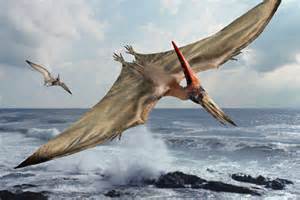
A pterodactyl with an eighty foot wingspan would not be able to fly on Earth but is able to fly on (this alternative version of) Venus because:

gravity is less;
air is thicker;
there is more oxygen.

At this point, sf readers remember:

many other fictional encounters with dinosaurs (see here);
Poul Anderson's question to John W Campbell - what comes next after fish, amphibians, reptiles and mammals?

Campbell suggested an animal that can energize its body by pumping atmospheric oxygen directly into its bloodstream. Anderson utilized this suggestion to imagine Ythrians, able both to fly under terrestroid conditions and to carry a body and brain heavy enough for intelligence.

Reading about Stirling's Quetzas and remembering Anderson's Ythrians, we next ask: do the conditions on Stirling's Venus allow for intelligent fliers?