Showing posts sorted by relevance for query Hell Rock. Sort by date Show all posts

Monday, 14 December 2020

Hell Rock Cratered, Molten, Congealed And Glowing

The People Of The Wind, VIII.

See Hell Rock. (Scroll down.)

When Ferune and his staff evacuate, he looks back. Hell Rock is cratered, congealed where it had run molten and in some places glowing. A hit on a site with defenses down would destroy the flagship outright. However, a sufficiently precise hit is unlikely so the Terrans do not waste their supermissiles against Hell Rock's remaining capacity to intercept them although they continue to snipe.

When Avalon strikes, Hell Rock is silhouetted against a fireball covering half the sky. Ferune at least takes a lethal dose of radiation so is he too killed by friendly fire?

In the case of Three Stars, a tracker torpedo bound for further out had detected the ship's emissions. Refinements like recognition circuits were not in place because the scale of the Avalonian response had sacrificed quality to quantity. Defending ships were not supposed to be as close in as Three Stars had become in her dog fight with Hooting Star which, having become an inert mass, was now safe from tracker missiles.

There are lessons in here somewhere.

Sunday, 9 November 2014

Hell Rock

When Terra attacks Avalon, Ferune of Mistwood, the First Marchwarden, commands the defense forces from the super-dreadnought, Hell Rock, named after an ancient battle site on Ythri, with the Anglic translation of the name painted on her side.

Hell Rock, a giant sphere or artificial planetoid orbiting Avalon and attended by small spacecraft, has awesome firepower, instruments and computers. Enemy ships attack but do not damage her. When she turns off a screen to launch missiles, energy weapons defend her temporarily exposed surface. Rays cannot be held steady long enough to penetrate her heavy plates. Radiation from exploding bombs has to pass through so many layers that it does not seriously harm the crew within.

Hell Rock blasts so many small ships that the Terran Admiral sends five capital ships with their attendants to destroy her. Many of her compartments are burst open to space. She fights on automatically as her crew leave when her command capabilities are no longer needed because the Avalonians have lost so many craft.

The Admiral has sent his five capital ships into a trap, doing exactly as the Avalonians had wanted. A massive megatonage of missiles hidden underground is launched simultaneously.

"Avalon struck...The skies erupted in radiance."
-Poul Anderson, Rise Of The Terran Empire (New York, 2011), pp. 535, 537.

Terra defeats the entire Domain of Ythri, except this one planet, Avalon.

Wednesday, 29 May 2013

Battles In Space


In Star Wars or Star Trek, we see space battles but, in Poul Anderson's History of Technic Civilization, we read about them in detail:

the superdreadnaught leading the defence of Avalon is named after the site of an ancient battle on Ythri;

First Marchwarden Ferune of Mistwood has had the Anglic translation of the name painted on the sides, Hell Rock;

the command bridge is broad because Ythrians need room to stretch their wings;

the air is scented with blood odors when the ship is in combat;

Ythrians, unlike Terrans, would go insane if confined in spacesuits so do not wear them and a large hole in a compartment will kill them;

Hell Rock, orbiting Avalon, built in space and unable to land, is a planetoid too massive for dodging manoeuvres but able endlessly to blast attacking ships;

when a section of screen is turned off to launch missiles, energy weapons intercept whatever is then launched against the temporarily vulnerable part of the hull;

rays strike the hull but never for long enough to penetrate the heavy plates; 

layers of internal shielding resist lethal radiation from explosions at the limits of Hell Rock's defences so that ordinary medication suffices for the little that does penetrate;

when, finally, concerted attack by five battleships and their attendants bursts Hell Rock open, bulkheads seal to protect those still alive and the artificial planetoid fights on automatically to cover her crew's escape.

The Terran Supernova class superdreadnaught, Valenderay, is even stronger but must not be risked because its armament and armor are there to protect fleet command. A Meteor-class boat, launched from a ship, has a captain, an engineer-computerman and a  fire control officer whose energy weapons counteract enemy torpedoes.

Anderson writes as if he had had combat experience in the Terran Empire.

Monday, 10 November 2014

Hell Rock Fights Again!

See Hell Rock.

Ferune's flagship, Hell Rock, was bombarded, battered and abandoned but remains in Avalonian orbit. When the Terrans attack the planet a second time, the wrecked flagship's automatic weapons open fire but she is so distant, and lacking in both ammunition and range, that she can easily be bypassed. The Terrans, falling into a second trap (see here), aim to land on the uninhabited Equatorian continent where they will build a bridgehead on the Scorpeluna plateau, which is isolated by air currents and surrounding mountains.

The outer planetary defense is fortresses of different sizes in hundreds of orbits and angles to the ecliptic, most automatic, all continually resupplied from the planetary surface but all now detected, and some destroyed, since the first Terran attack. Squadrons approach at high velocity and acceleration, enter range of a target, fire missiles, then flee at unpredictable vectors, making as many passes as necessary to destroy a fortress. Missiles rising through atmosphere against gravity from zero initial speed cannot hit such spacecraft and stop trying.

The Imperials destroy only those fortresses that would threaten their landing force but also bombard the moon, Morgana, where they destroy mountains, and hit the Avalonian town, Centauri, with radiation, thus diverting Avalonian resources into relief and rescue and preventing any counterattack from that quarter. Small Terran ships escort the landing craft, stopping missiles, then attacking their source, hitting negafields and bunkers with beams and torpedoes, completing the job on a second pass. The Terrans are down and in trouble.

Thursday, 13 January 2022

Fare Gladly

The People Of The Wind, VIII.

Hell Rock fights on automatically, covering the retreat of the last of her crew who are Ferune, his staff and:

"...a few ratings from Mistwood who had been promised the right to abide by their Wyvan." (p. 534)

Ferune looks back at Hell Rock, ragged, crumpled, cratered, molten metal congealed or glowing, and whispers:

"'Fare gladly into the winds...'" (ibid.)

We had been told of Ferune that:

"He had scant patience to spare for tradition, religion, any conservatism. He endured a minimum of formalities because he must, but never claimed to like them.'" (II, p. 455)

Now, however:

"In this moment he put aside his new ways, his alien ways, and was of Ythri, Mistwood, Wharr, the ancestors and the children." (pp. 534-535)

In such a moment, I would not recite the prayers that I was taught in childhood but would certainly repeat their words for anyone who asked me to. Djana surprises Flandry:

"'Hail Mary, full of grace -'
"Her? And he thought he'd gotten to know her!"
-Poul Anderson, A Circus Of Hells IN Anderson, Young Flandry (Riverdale, NY, 2010), pp. 193-365 AT CHAPTER FIVE, p. 225.
 
His thought at the same time is:
 
"...it had been fun living." (ibid.)
 
Back to Ferune and his crew, they are indeed near death. They take what turns out to be a lethal dose of radiation when Avalon strikes.

Monday, 10 November 2014

All The Traps Of Avalon

Chapter Seventeen
On the Scorpelunan plateau in Equatoria, hexapods graze under their parasol membranes. Packs of dog-sized hexapodal lycosauroids and throngs of twenty centimetre long cockroach-like kakkelaks attack Terran invaders who are being slowly poisoned by hell shrubs. Furious tropical storms caused by high irradiation and fast spin delay evacuation.
-copied from here.

Trap One
The artificial planetoid, Hell Rock, destroys so many small spacecraft that the Terran Admiral sends five capital ships with their attendants against it. When the five are close enough, they, and many other Terran ships, are destroyed by an unexpected and massive missile barrage from hidden installations on the planet.

Trap Two
Avalonian disinformation convinces the Terrans that the uninhabited continent, Equatoria, is undefended and that they will be able to establish an unassailable beachhead there. The result is as in the passage copied above. The evacuation is hindered by winged Ythrian guerrillas and also by human Avalonians entering Equatoria bringing short-range missiles and massive energy projectors, the latter to be assembled on peaks overlooking the Terran-occupied plateau. The Terran fleet, now trying to destroy all the remaining orbital forts in order to enable their transports to move continuously, cannot afford to expend missiles against the Avalonian spacecraft that now return from the outer Lauran system to attack Terran warcraft escorting improvised hospital ships. The First Marchwarden broadcasts that Avalon will admit Terrans to prepared hospitals when the ceasefire is restored and the fleet withdraws.

Monday, 13 April 2020

Space Battle

"Cold Victory."

In space, a dozen men in combat armor, carrying rifles, fly on individual jet-units powered by beams from their spaceship's nuclear engines. Interplanetary beam power was developed in the previous story, "Holmgang."

The Terrestrial flagship, Monitor, was built only the previous year, thus by the revolutionary Humanist government. A giant spheroid, never meant to land on a planet, it has visible gun turrets and is the only spaceship designed for no purpose other than to kill. Crane's small group destroys it.

The Monitor is an indictment of the Humanists and also is reminiscent of similar engines of destruction in Poul Anderson's Technic History. See Hell Rock.

Thursday, 20 June 2019

Reduction Of A Planet

The People of The Wind, XVII.

When the Imperial armada englobes and attacks Avalon, fireballs in space hurt eyes and cast shadows on the surface. The wrecked and abandoned artificial planetoid, Hell Rock, detects and fires on the enemy but is weak enough to be bypassed. The remnant Avalonian navy gathers and skulks one or two a.u.s away.

The armada systematically reduces orbital fortresses in hundreds of orbits at hundreds of angles. Continually resupplied from the surface, the fortresses are mostly automated and some have remained undetected. Squadrons repeatedly attack at high acceleration and recede at unpredictable vectors. Missiles rising through atmosphere against gravity "...from zero initial speed..." (p. 626) cannot hit such ships and stop trying. On the moon, Morgana, mountains crumble and valleys become molten.

The armada focuses on those fortresses that would threaten the intended landing force and also on those surface defenses that start to destroy ships as they approach the atmosphere.

Yet again, Poul Anderson writes like a veteran of space combat.

Sunday, 19 March 2017

Empires

Science fiction, including Poul Anderson's sf, covers interstellar empires. This can lead to reflection on the reasons for imperialism whether planetary or interstellar. See here for an alien empire and many other posts for the Terran Empire of the Technic History.

SM Stirling's Sir Nigel Loring summarizes the British Empire pithily:

presence of mind;
profit;
preaching;
philanthropy;
plundering;
pinching land.

He adds:

"'...keeping the bloody Frogs out.'"
-SM Stirling, The Protector's War (New York, 2006), Chapter Eighteen, p. 497.

("Frogs" are the French.) Sir Nigel might perhaps have summarized this anti-French policy as "prevention" or "pre-emption."

Stirling reminds or informs us that horses injured in battles scream and that the historical castles of Britain and Europe would become useful again if history took a different course. Poul Anderson imagines orbital forts like Hell Rock.

Thursday, 3 January 2019

A Reminiscence Of Ferune

Poul Anderson, The High Crusade,  CHAPTER XVI.

See Hell Rock.

Deception continues. Having captured secret Wersgorix weapons, the English can present the secret weapons to other races as English. Sir Roger conceals his men's ignorance of spaceship weapons by deploying them in small fast craft.

A space battle resembles those in the Technic History (see the above link):

unimaginable distances;
fire-beams;
shells;
missiles;
artificial brains directing the ships;
artificial gravity;
ship sections self-sealing when damaged;
a mile-long, forcefield-protected flagship boarded by Sir Roger's space-armored, sword- and ax-wielding men who easily defeat a crew untrained in hand-to-hand combat - the hull is abandoned, then explodes.

"...many a sober, trustworthy man-at-arms swore that he saw [St. George] ride down the Milky Way in a foam of stars and impale enemy ships on his lance like so many dragons." (p. 121)

The Wersgorix, trapped by a surprise attack between their former colony planet and the allied fleet, suffer heavy losses and withdraw. 

Monday, 14 December 2020

Space Battle II

The People Of The Wind, VIII.

When Three Stars is launched from her cruiser, she immediately detects an unaccompanied and interceptible Terran Meteor. Rochefort sees an approaching enemy boat decorated with three golden stars. He thinks that it is odd that Ansa has come so close without opposition. Little does he suspect that planet-based defenses will strike when enough large Terran ships have been lured to attack Hell Rock.

A Terran torpedo misses Three Stars because Vodan is decelerating. It turns to seek but one of Vodan's gunners destroys it. After maneuvering, the Meteor releases radar window but Vodan knows where to aim his energy beams. When the Meteor becomes visible, she has stopped accelerating and air gushes from a gaping hole in her powerplant.

Wa Chaou is dead. Vodan radios. Rochefort surrenders. He and Helu prepare to transfer to the Ythrian. Avalon strikes. Friendly fire obliterates Three Stars. Hooting Star must crash land on Avalon.

Monday, 30 June 2014

Literature

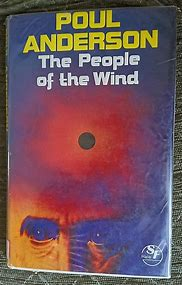
(This cover illustration looks like Rochefort attacked by an Ythrian.)

Ferune, Wyvan of Mistwood Choth on Avalon and First Marchwarden of the Lauran System, reads:

"...Terran classics...in three original languages, for enjoyment."
-Poul Anderson, Rise Of The Terran Empire (New York, 2011), p. 454.

In the command bridge of his superdreadnaught, Hell Rock, before battle, he remembers:

"The fear of a king is as the roaring of a lion; whoso provoketh him to anger sinneth against his own soul." (p. 519)

When he sees Morgana, the moon of Avalon, moving around the dark side of the planet, he murmurs, "Oh moon of my delight that knows no wane -" (p. 526).

We would like to hear more from Ferune but he dies in this conflict. Anderson not only quotes Terran classics but also transposes the alliterative verse form into Planha, which Arinnian translates into Anglic:

"Blind in the black of clawing cloudbanks,
"wins he his way, though slowly,
"breaks their barrier, soars in sunlight.
"High is heaven and holy." (p. 452)

And that last quoted line concludes the novel:

"Snowpeaks flamed. The sun stood up in a shout of light.
"High is heaven and holy." (p. 662)

Sometimes, we forget space battles and enjoy Poul Anderson's use of the English language.

Monday, 24 October 2016

Battle At Satan

I am losing count of David Falkayn's moments of realization. Here is another:

"Wait! Drag that thought by slowly. You'd started playing with it before, when Chee interrupted -
"Falkayn sat rigid, oblivious, until the Cynthian grew nervous and shouted into the intercom, 'What ails you?'
"Oh.' The man shook himself. 'Yes. That. How're we doing?'" (David Falkayn: Star Trader, p. 507)

He has just realized how his single ship can defeat a fleet. We are about to read about yet another space battle. See Battle In Space, Hell Rock and The War Against The Seven In Space.

Gahood of Dathyna arrives near Satan with a fleet:

he and his single human assistant are in a large spherical battleship, its shape obscured by towers, pillboxes, derricks and emplacements;

Gahood also controls nineteen streamlined robotic destroyers and three shark-like robotic cruisers;

all twenty three vessels bristle with guns, missile launchers and energy projectors.

How much damage can Falkayn and Chee Lan in Muddlin' Through do to all that? Quite a lot. Muddlin' Through, controlled by the consciousness-level computer, Muddlehead, has small arms, light guns, four heavy blast cannon and four nuclear torpedoes. Falkayn, invited aboard the Dathynan battleship to be interrogated by Gahood, goes booby trapped and barely escapes with the human Hugh Latimer as a hostage. Chee Lan gets the Dathynan coordinates out of Latimer's brain. When Gahood realizes that he has retrieved from space not Latimer but his empty spacesuit, he attacks. Muddlehead leads the nineteen destroyers into a Satanic hurricane which destroys them utterly. The cruisers, orbiting Satan against possible space attack, which Falkayn has led Gahood to expect, are attacked by Muddlin' Through. Two are destroyed by torpedoes but a countermissile intercepts the third torpedo so Falkayn launches his fourth which has a near miss and badly damages the one surviving cruiser. Gahood retreats and returns home, not knowing that he can now be followed. You win this time, Earthlings!

Saturday, 8 June 2019

Ythrians At War

The People Of Wind, VII.

Points of Interest
(i) Ferune had planned to bring his own mate, Wharr, with him as often before but she was unwell.

(ii) His aide says, "'Foully thin information,'" (p. 517) nonverbally, with feathers and attitude.

(iii) The two are alone on the broad bridge because Ythrians need room to stretch their wings.

(iv) The air is scented with cinnamon and amberdragon.

(v) Blood odors will be used to stimulate the crew in combat but would wear them out if overused.

(vi) Ferune, like Cajal, is in a superdreadnaught.

(vii) She is named Hell Rock "...after the site of an ancient battle on Ythri." (p. 518) Ferune has had the name painted big on the sides. He wants the Terrans to get the message.

(viii) He quotes the Bible.

(ix) The omniscient narrator descends from his throne of omniscience to address his audience in lecturer mode when he deploys a verb in the imperative mood: "Consider:..." (p. 519) before explaining linear acceleration.

Comment
Back in Chapter IV, Eve Davisson did not join the peace demonstrators on Esperance but I would have done: "For Peace and Planetary Self-Determination!"

Sunday, 20 September 2015

A Sword Fight

See Hell Rock, Battle In Space II, Battle At Sea and Gorrazan II.

I find it interesting to analyze Poul Anderson's accounts of combat. Anderson's Time Patrol series concludes with "Death And The Knight," which in turn concludes with a section headed:

PARIS, WEDNESDAY, 11 OCTOBER 1307

In Time Patrol (New York, 2006), this section comprises exactly seven pages of text, beginning on p. 758 and ending on p. 765. Two of these pages, 761-762, describe a sword fight.

Manse Everard leads four Patrol colleagues in a night-time attack on a house of the Knights Templar in order to rescue their fellow Patrol agent, Hugh Marlow, held prisoner by the Knights. Firing a hardwood missile from a specially designed mortar, the Patrolmen break down the door, creating the impression that a band of uncommonly strong marauders has used a battering ram.

Expecting only the prisoner, two guards and a scullion, Everard is alarmed to find that a Knight, Fulk de Buchy, has stayed over and recalled the household staff, several men and boys, unwelcome witnesses to the attack. Everard's men tackle two halberdiers while Fulk attacks Everard. The Patrolmen's weapons conceal sonic stun guns which must however be used surreptitiously in order to avoid any semblance of miracle or magic. Everard could be killed here. Could he? None of his twentieth century colleagues would knowingly send him to his death but, as time travelers, how can they avoid sometimes knowing the time and place of a colleague's death while still speaking to him?

Everard blocks Fulk's longsword with his falchion and prepares to deliver an unheard of uppercut but Fulk glides aside and now fights with a glaive. Everard counters with karate moves. Martial arts enable him to "...hit the floor in full control..." (p. 762) and to strike upwards with his falchion, mortally wounding Fulk, while his companions stun the pikemen. The household staff flee. Everard's men grab well-made loot both to simulate a hasty robbery and to preserve some artifacts for future museums. They rescue Marlow, who takes time to regret the death of his lover, Fulk. The Time Patrol series ends with:

"'Let's go,' Everard said, and led them away." (p. 765)

Thursday, 30 May 2013

Yet More On The People Of The Wind


I am posting while rereading. Thus, new points keep coming up.

(i) We learn another Nuevo Mexican place name: the Admiral had hunted in the Sierra de los Bosques Secos.

(ii) We learn more about the wreck of the Avalonian flagship, Hell Rock: when the Terrans invade, "...the robots within knew their foe and opened fire." (Rise Of The Terran Empire, New York, 2011, p. 625). But this "...poor old hulk..." is too far away and has too little ammunition or range to be worth the trouble of demolition.

(iii) Tabitha Falkayn describes the behaviour of "birds," human choth members: "'...promiscuous as kakkelaks...'" (p. 509) Later, she warns a Terran prisoner of war about some Avalonian ecological dangers: "'...if a kakkelak swarm started running up your trousers...'" (p. 570) Later again, we see kakkelaks in action against Terran invaders:

"Energy weapons incinerated at a flash hundreds of the cockroach-like things, twenty centimeters long, whose throngs blackened the ground between shrubs. They could not save the men whom these bugs had already reached and were feasting on...Having evidently gotten wind of meat in this hungry land, the kakkelaks swarmed toward the main base." (p. 637)

Good descriptions. My problem is I doubt whether any extra-solar planets will be even that hospitable!

Thursday, 9 March 2017

Another Battle At Sea

Battle At Sea
Battle On The Sand
Battle In Space
Hell Rock

To these, add the Battle of the Cutty Sark in SM Stirling, The Protector's War (New York, 2006), Chapter Eight, pp. 227-237.

I really dislike mass slaughter and hope that mankind stops doing it soon. However, it is part of our history and can be exciting to read about even when it involves a man's head being smashed like a melon dropped on concrete. (Stirling, p. 230)

When a band of archers efficiently kills a horde of attacking pirates, thus saving some of their own lives, then there is some satisfaction in reading about a job well done. As the Tasmanians approach the pirates from the rear, one looks back - and John Hordle puts an arrow through his mouth and neck from a moving platform at nearly two hundred yards. The pirate drops unnoticed by his comrades. We have celebrated Hordle's archery before.

Wednesday, 31 January 2024

Trap One

The People Of The Wind
, VIII.

The Terran Admiral Cajal's flagship, Valenderay, classed among naval craft as a "Supernova," is even more powerful than the Avalonian Ferune's flagship, Hell Rock. However, the latter, an artificial planetoid, does not manoeuvre but remains in close orbit, drawing enemy fire. She is far too well armoured and defended to be damaged even by a large horde of small attack craft yet must be destroyed before the Terrans can threaten Avalon. Consequently, Cajal sends four capital ships and their attendants against her. He has fallen into the first trap. (There will be a second, on the planetary surface, later.) When the ground-based defence forces strike, Cajal loses significantly more of his fleet than he had expected to and is obliged to withdraw. Pretty smart stuff. Poul Anderson knew how to write military sf.

That devastating Avalonian strike has lethal consequences even for some of the planet's defenders but nevertheless it achieves its purpose of preventing immediate subjugation of the planet. Readers are mainly on the side of the defenders but also see the Terrans as good people. This is a story basically without villains. I am inclined to see Governor Saracoglu, who had promoted the war, in that role but he remains in the background. 

(That book cover rightly shows an Ythrian as winged and feathered but wrongly shows him as beaked.)

Monday, 7 November 2016

Into Battle

How do men and indeed beings prepare to go to war? In The People Of The Wind, Chapter VII, Poul Anderson presents a Terran Admiral and the two Marchwardens of the Lauran System.

Admiral Cajal

The Admiral thinks:

"Man's duty in this life...is to choose the lesser evil." (Rise Of The Terran Empire, p. 514)

That is Krishna's teaching to Arjuna in the Bhagavad Gita. To summarize my understanding of Krishna's teaching:

Arjuna must carry out his duty as a kshatriya, a member of the warrior/ruler caste;
inaction is impossible;
there is inaction in action and action in inaction;
I (Krishna speaking as the supreme deity) act and My action sustains the universe;
at the Battle of Kurukshetra, the destruction of the enemy is a lesser evil than their continued existence;
act without attachment.

While I accept the teaching of nonattached action, I think that there are times when we can go beyond "the lesser evil." Sometimes canvassers solicit my vote with the argument that their political party is a lesser evil than its main opponent! I say offer me a higher good - or let's campaign for one.

Cajal, safe at the center of a superdreadnaught behind his fleet but all too conscious of sending others to their deaths, glances at a picture of his dead wife, listens to Bach's Passacaglia, which they had both liked, takes off his bonnet, kneels, signs himself and prays before a crucifix.

Second Marchwarden Holm

Daniel Holm, coordinating Avalonian defense, embraces his wife.

First Marchwarden Ferune

Although Ferune, in his superdreadnaught Hell Rock, is Ythrian, he remembers:

"The fear of a king is as the roaring of a lion..." (Proverbs 20:2)

Some human beings would empathize with Ferune more than with Cajal!

Monday, 14 December 2020

The People Of The Wind In Space

The People Of The Wind, VII.

Differences Between Ythrian And Terran Spaceships
(i) In an Ythrian warship, the air is scented with blood odor to stimulate the crew during combat although not before because constant stimulation would wear them out.
 
(ii) Ferune's wife, Wharr, has accompanied him on naval expeditions, has borne and raised children in a homeship attached to the fleet and has drilled and led gun crews.
 
(iii) Ythrian ships are larger because the crew need room to stretch their wings.

(iv) Ythrians would not remain sane wearing spacesuits and therefore are vulnerable to a breach in the hull.

(v) Ythrians put personal symbols on lesser craft, e.g., the three stars on Vodan's torpedo launcher. In addition, Ferune has had Hell Rock painted in Anglic on the sides of his super-dreadnaught.

In "Lodestar," we are told that an Ythrian ship has:

a large, otherwise unnecessary, viewport because the crew need an ample outlook;
a hold spacious enough to allow the crew to fly.